
Bridging the Data Gap: A Smarter Dundee and Tay Road Bridge
Supported by Tay5G, Digiflec’s smart sensors deliver real-time traffic insights to help manage 27,000 daily vehicle crossings and plan maintenance—without digging up the road.
(This story was originally published by Digiflec.)
This project was led by Diigiflec, based in Fife, Scotland and supported by the Tay5G Challenge Fund 1. It was delivered in collaboration with The Scotland 5G Centre and Jack Waland of Folk Consulting.
Dundee City Centre and the Tay Road Bridge
The Tay Road Bridge was completed in 1966. Managed by Alan Hutchison, it serves as a critical connection between Dundee and Fife, handling around 27,000 vehicles daily alongside pedestrian and cyclist traffic. Its daily operations rely on a comprehensive surveillance system with 32 cameras to monitor usage and condition.
Case study: Tay Road Bridge, Enhancing Operations with Connected Intelligent Infrastructure Monitoring platform (CiiM)
https://www.youtube.com/watch?v=yK3WlJogjJs
This is a recorded webinar discussing the integration of LiDAR technology in monitoring and enhancing infrastructure efficiency on the Tay Road Bridge in Dundee. Experts from Digiflec, the Scotland 5G Centre and Dundee City Council/Tay5G share insights on how this technology contributes to the development of smart cities by improving traffic flow, structural health monitoring, and safety measures.
Smart Cities, IoT and Digital Twins - and Digiflec
The Tay Road Bridge project shows how smart sensing can support smarter cities, turning real-time information about traffic and infrastructure use into practical decisions about maintenance, investment and services. This is part of th realm of the Internet of Things (IoT). This connects physical devices and sensors so they can collect and share data, helping organisations monitor conditions, manage infrastructure and respond to changes in real time.
This data also contributes to digital twins—digital representations of physical places or assets that can be updated with sensor information to reflect changing conditions. Combined with suitable models, digital twins can help organisations explore scenarios, anticipate pressures and test potential improvements before making changes on the ground. Digiflec’s work demonstrates a building block for this approach: reliable information about how infrastructure is used, helping public authorities and owners of other built assets manage them more effectively.
Digiflec specialises in 3D sensing and intelligent infrastructure monitoring, combining LiDAR sensors with software that turns data about vehicles, people and spaces into useful operational insights.
The Challenge
The Tay Road Bridge team encountered several operational challenges:
Delayed Data Retrieval: The existing system necessitated quarterly physical data collection from traffic loops embedded in the road surface. This process led to a significant delay in data availability, hindering timely decision-making.
Intrusive Installation and Maintenance: The traffic loops required disruptive installation procedures and regular maintenance, which complicated operations and risked road surface integrity.
Limited Insight into Road Degradation: The previous technology provided insufficient data on vehicle types and weights crossing the bridge, a critical factor in understanding and addressing road wear and tear.
The Solution
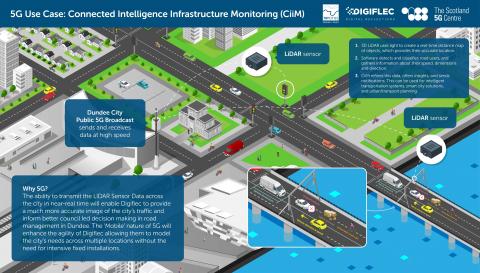
To address these challenges, Digiflec proposed integrating 3D LiDAR sensors and their sensor agnostic CiiM (Connected Intelligent Infrastructure Monitoring) service on the Tay Road Bridge. CiiM unlocks valuable data insights derived from LiDAR sensors, regardless of the specific sensor model used.
CiiM offered significant advantages over the existing traffic loop system:
- Real-time Data Collection: CiiM enables continuous, real-time traffic flow monitoring, eliminating data acquisition delays.
- Non-intrusive Installation: Digiflec can install LiDAR sensors without disrupting the road surface, preserving the bridge’s structural integrity and avoiding traffic delays.
- Enhanced Traffic Analysis: CiiM provides valuable insights into traffic patterns and load distribution by differentiating between vehicle types and assessing their weights.
Benefits
The adoption of LiDAR technology has significantly enhanced the bridge management team’s capabilities:
- Improved Maintenance Scheduling: With real-time data, the team can prioritise maintenance activities more effectively, focusing on areas with higher wear and tear.
- Informed Capital Expenditure: Insights into the types of vehicles using the bridge and their impact on its structure allow for better resource allocation for its upkeep.
- Increased Operational Efficiency: Monitoring traffic flow and vehicle types in real time facilitates more responsive management of the bridge’s infrastructure.
Looking ahead, the bridge management team anticipates further advancements in CiiM, particularly in recognising signs of distress among bridge users. This development could play a pivotal role in enhancing safety measures and providing timely assistance to individuals in need.
Working with Digiflec
The collaboration with Digiflec proved to be seamless and productive. The Digiflec team was responsive, adapting their technology to meet the bridge’s specific needs while also proposing new applications for the sensors. Their approach not only addressed the immediate challenges but also laid the groundwork for future enhancements in bridge safety and operational efficiency. The positive experience with Digiflec illustrates the potential of combining public infrastructure with innovative technology solutions for mutual benefit.
A Leap Forward on smart cities
The collaboration between the Tay Road Bridge authority and Digiflec represents a significant leap forward in bridge monitoring and management. By leveraging LiDAR technology, the team has overcome substantial operational challenges, paving the way for future enhancements that promise to further secure the bridge’s legacy as a vital transport link and a testament to modern engineering.